An Option for Adults Who Don’t Want a Brace
Episode overview
If you’re an adult with scoliosis, you may already know the feeling: one side feels tight, the other side feels weak, your posture shifts when you get tired, and your back keeps reminding you that something is off. In this episode, we talk about a different approach for adult scoliosis pain: specialized taping combined with postural exercises.
This episode is for people who want support, better movement, and less pain—but do not want to wear a bulky brace as an adult. We break down what this approach is, what it is not, and why the right evaluation matters before trying anything.
Who this episode is for
This episode is for adults with scoliosis who have:
- Back pain that seems tied to posture
- Uneven shoulders, ribs, waist, or hips
- A body that feels twisted, pulled, or stuck
- Pain that gets worse with standing, sitting, or fatigue
- No interest in wearing a rigid brace as an adult
- Tried stretching, massage, or basic care, but the same pattern keeps coming back
It may also be helpful for parents of teens with scoliosis who want to better understand how posture, breathing, muscle tension, and body awareness can all matter.
The big idea
Scoliosis is not just a sideways curve. It is a 3D body pattern. That means the spine can curve, rotate, and pull the ribs, pelvis, shoulders, and muscles into a pattern over time.
Because of that, care should not only focus on the painful spot. The goal is to understand the whole pattern and help the body move in a better way.
Key takeaways
- Scoliosis affects more than the spine. It can change the ribs, pelvis, shoulders, muscle tension, and posture.
- Adults with scoliosis often want less pain and better function—not a bulky brace.
- Specialized taping can give the body a gentle reminder and support a better posture pattern.
- Postural exercises help teach the body what to do with that new input.
- Tape is not the full treatment. It works best as part of a curve-specific plan.
- Two people with scoliosis can need very different care, which is why a real evaluation matters.
What this taping and postural exercise approach is
This approach uses specialized taping plus specific postural exercises to help support better posture, body awareness, and movement. The taping is worn on the skin for several days at a time and can often fit into normal daily life without being obvious.
The exercises are designed to work with the person’s scoliosis pattern. The goal is to help the body feel and practice a better position—not just once in the office, but over and over again in daily life.
What it is not
This is not “magic tape.” It is not just putting tape on where it hurts. It is not a one-size-fits-all plan. And it is not a promise that tape alone fixes scoliosis.
Instead, it is one part of a bigger strategy to improve posture, reduce pain, and help the body move better.
Why adults care about this
For kids and teens, scoliosis treatment often focuses on growth and preventing progression. For adults, the conversation is often different. Adults usually want:
- Less pain
- Better posture
- Better breathing and movement
- Less fatigue
- More confidence in how their body feels
- A practical option they can live with
That is why this kind of approach can sound appealing to adults who say, “I know my scoliosis affects me, but I’m not wearing a brace.”
Common signs of scoliosis
Some of the common signs mentioned in the episode include:
- Uneven shoulders
- Uneven shoulder blades
- Uneven waistline
- One side of the ribs sticking out more
- Hips looking uneven
- A trunk or torso that looks shifted
- Feeling twisted or compressed on one side
These signs do not all mean the same thing, which is another reason the evaluation matters.
Why evaluation matters
This may be the most important part of the episode.
Two people can both say, “I have scoliosis,” and still need completely different plans. One person may need more rib and breathing work. Another may need more pelvic correction. Another may need muscle release first. Another may be a strong fit for taping plus curve-specific exercises.
That is why the right next step is not guessing. It is getting a clear look at:
- Where the curve is
- Where the rotation is
- What side is compressed
- What side is overworking
- What hurts
- What movement patterns are driving the pain
episode timestamps
- 0:00 — Why adult scoliosis can feel so frustrating
- 1:45 — Scoliosis is more than “a curve”
- 3:40 — Why adult goals are different from teen scoliosis goals
- 5:30 — Why many adults do not want a brace
- 6:45 — What specialized taping may help with
- 9:00 — Why tape is not enough by itself
- 10:20 — How postural exercises fit into the plan
- 12:15 — Why scoliosis care has to be curve-specific
- 14:30 — When this approach may be worth exploring
- 16:00 — Why the evaluation matters most
- 17:30 — Next steps and how to schedule
FAQ
Is this a replacement for a scoliosis brace?
Not always. For some people, especially adults, the goal may be pain relief, posture support, and better movement rather than full-time brace wear. The right answer depends on the person’s age, curve, symptoms, and goals.
Can adults still improve if they’ve had scoliosis for years?
Many adults can still work on pain, posture, movement, and function. The goal is usually not perfection. The goal is progress and better quality of life.
Is the tape visible?
Often, it can be worn under normal clothing and may not be obvious to other people.
Does the tape do all the work?
No. The tape is there to support and remind. The exercises and the full care plan are what help teach the body how to move differently.
How do I know if this is right for me?
You need a proper evaluation. That is the only way to know whether this kind of approach fits your specific scoliosis pattern and symptoms.
Resources
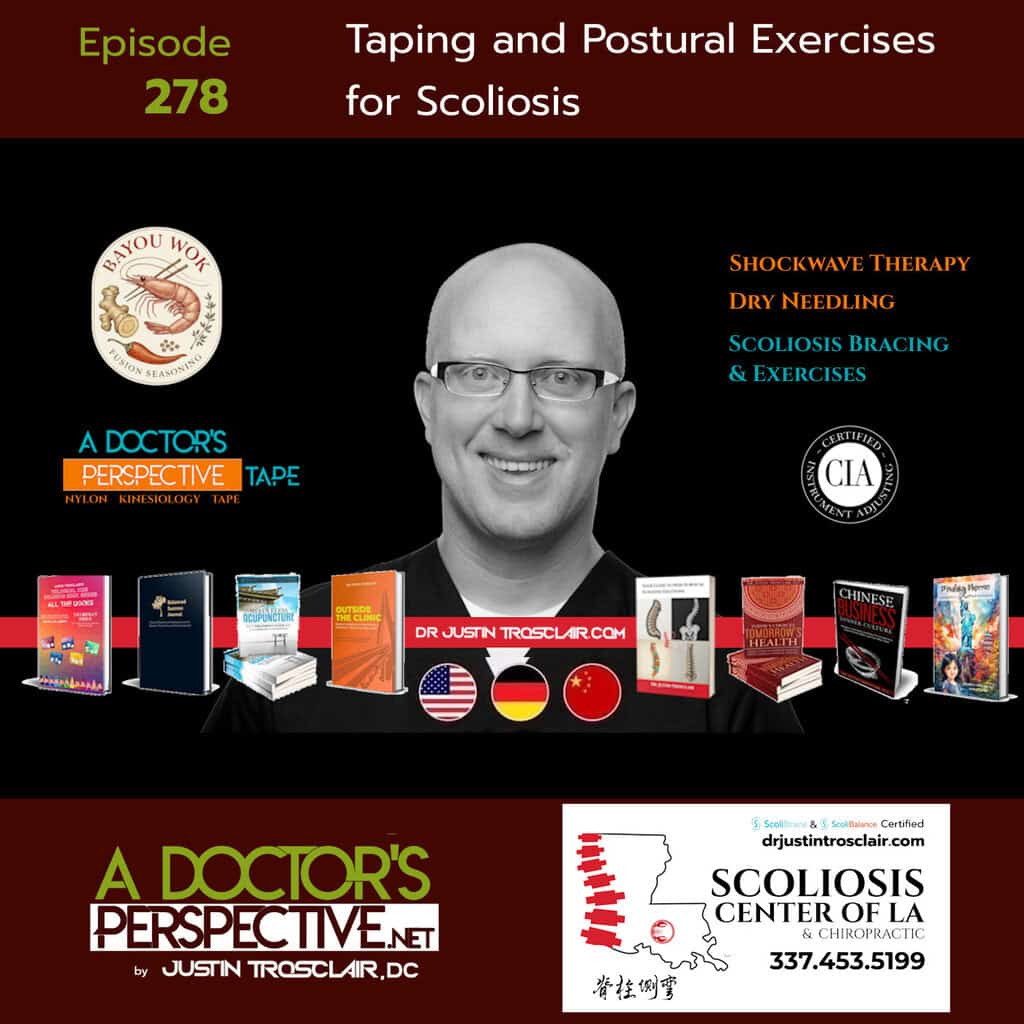
To learn more about scoliosis, scoliosis bracing, chiropractic, taping, shockwave therapy, and dry needling, visit the full article.
Next step
If you are dealing with scoliosis pain and want to know if this kind of taping and postural exercise approach fits your case, the next step is a real evaluation.
Call or text 337-453-5199 to schedule.
Short podcast platform description
Adult scoliosis pain can feel frustrating, especially if you do not want to wear a brace. In this episode, we break down how specialized taping and postural exercises may help support better posture, less pain, and better movement. If you want to learn more or schedule an evaluation, visit drjustintrosclair.com or call/text 337-453-5199.