Effective Interventions & Best Practices
Scoliosis care gets simpler when you anchor to three things: early detection, growth risk, and the right escalation path. This clinician-focused episode walks through AIS vs adult scoliosis, where PSSE and bracing fit, when to refer for a surgical opinion, and how to support adherence—especially in adolescents managing a brace and a demanding rehab routine.Read the full article: https://drjustintrosclair.com/treating-scoliosis-effective-interventions-and-best-practices-for-doctors
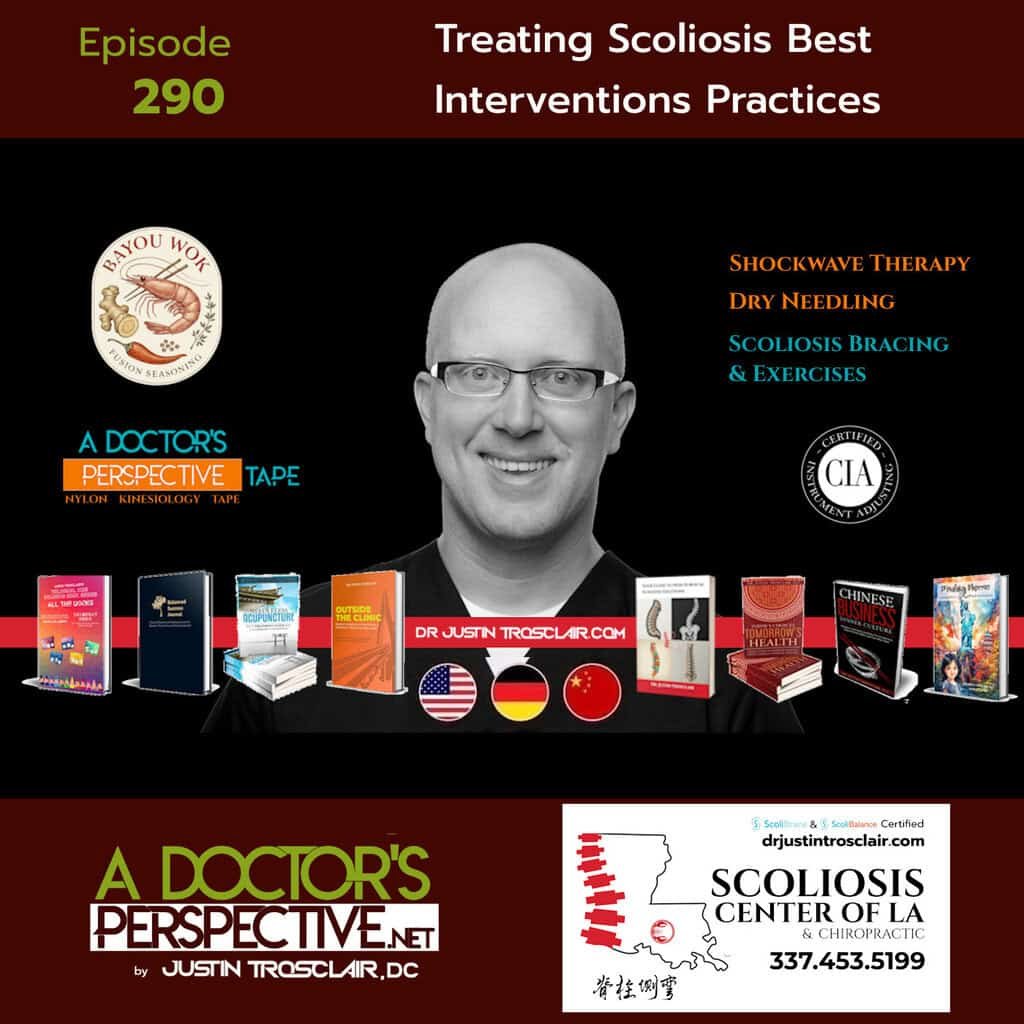
Episode Summary
Early diagnosis matters most during rapid growth, when progression risk is highest and deformity can accelerate. In adolescents, curve size plus growth status drive decision-making; in adults, even smaller curves can be clinically meaningful because pain and dysfunction can occur regardless of Cobb magnitude, and selection is not based solely on curve size.
This episode reviews a practical conservative pathway for AIS—PSSE first in lower curves, PSSE + 3D bracing when curves progress and growth remains, and surgical opinion when the curve reaches the severe range. It also covers adult approaches (AIS carryover vs de novo/degenerative scoliosis) and patient-support strategies that improve follow-through.
Key Definitions & Clinical Categories
- AIS (Adolescent Idiopathic Scoliosis): typically diagnosed ages 10–18 when no identifiable cause is found.
- Adult scoliosis: may be AIS persisting into adulthood or adult-onset de novo/degenerative, often linked with instability and listhesis.
- Definition of scoliosis: a 3D deformity with ≥10° Cobb angle plus rotation.
Treatment Pathway (From the Article)
1) AIS: PSSE early (lower curves) PSSE is presented as effective for curves up to approximately 20–25°, particularly when started early. The article lists ScoliBalance® as an example PSSE program combining chiropractic, physiotherapeutic, and exercise rehab principles.
2) AIS: PSSE + 3D bracing when curves progress and growth remains When curves move beyond ~20–25° and the child is still growing, the article recommends combining PSSE with a custom-made 3D brace (noted as designed using the BraceScan app to reduce human error). The brace referenced is ScoliBrace®.
3) AIS: surgical opinion in severe curves For curves beyond approximately 45°, the article notes that a surgical opinion is often recommended, typically involving spinal fusion. That doesn’t mean a brace can’t help a 45 curve but it’s time to get an ortho’s opinion.
4) Adults: symptom-led selection + bracing for symptom management Young adults with AIS may follow adolescent-like approaches depending on flexibility/deformity. Degenerative/de novo adults may use PSSE but are not selected solely by Cobb angle; a 3D custom brace may help manage symptoms such as pain.
Supporting Patients (The Part That Makes or Breaks Outcomes)
The article emphasizes that adolescents often face major stressors—decision burden, uncertainty, appointments, exams, rehab commitment, and bracing—during a sensitive developmental stage.
Practical support strategies listed:
- Ensure care is provided by a certified clinician specializing in scoliosis-specific rehab.
- Foster open communication across the healthcare team and involve the adolescent in planning.
- Provide audio recordings of exercises so the patient can practice with voice instruction at home, reducing parent-child conflict.
- For adults: emphasize self-management strategies, since visit frequency may be lower and motivation is often symptom-driven.
Tips for Clinicians (From the Article)
- Encourage regular PSSE practice.
- Answer what’s in scope; refer out when it’s beyond your expertise.
- Expand scoliosis training via courses/webinars: https://scolicare.com/academy
- Ensure patients understand program responsibilities and have access to their plan.
- Help brace adaptation by encouraging openness (acceptance vs concealment), monitor discomfort, and communicate brace-related pain/issues back to the treating clinician.
Call to Schedule / Refer
The article includes a call to schedule or refer for a doctor consult: 1 337 453 5199.
References (Listed in the Article)
The article includes a full reference list (screening, SOSORT guidelines, progression risk, bracing evidence, PSSE trials, adult deformity reviews, and psychosocial impact literature).